
SCIANCE has concluded its call for experts for the AI in Science Working Groups. A total of 655 applications were received, demonstrating the interest across scientific communities to develop a cohesive framework for Artificial Intelligence in European research.
Over 650 experts applied to shape the Future of AI in Research
Two months ago, we asked AI experts accross Europe to join our AI in Science Working Groups. With over 650 applications, actors from academia, research centres, infrastructures, and industry have showed a massive interest in joining one or more working groups. Currently, SCIANCE partners are evaluating all applicants, ensuring that all working groups have a balanced composition – we are identifying experts with the most relevant expertise and the ability to contribute to our activities, while at the same time also ensuring sufficient diversity accross disciplines, EU Member States and Associated Countries, career stages, and gender. We will aim for a broad representation from diverse stakeholder communities, including academia, industry, research infrastructures, civil society, and public bodies.
While we are evaluating all applicants, we want to share already some results from a first analysis of the results.
Please note that, while the applications are formally closed, we are still working on cleaning and deduplicating the data. Final numbers can vary slightly from the statistics presented here.
Geographic and Disciplinary Diversity
The Data Science and Analytics topic emerged as the most popular (277 applicants), followed by AI for Academic Workflows (262) and AI for Scientific Discovery (246). The popularity of these cross-cutting topics show that AI has become a foundational element of the modern research lifecycle. The top domain-specific expertises indicated are Social Sciences and Humanities (145) and Life Sciences (132).
The call revealed a deep interest in the ethical and structural aspects of technology. Nearly one-third (211) of all applicants expressed expertise in Open Science, ethics, and FAIR AI, ensuring that the working groups will prioritise transparency and trustworthiness as they develop their recommendations.
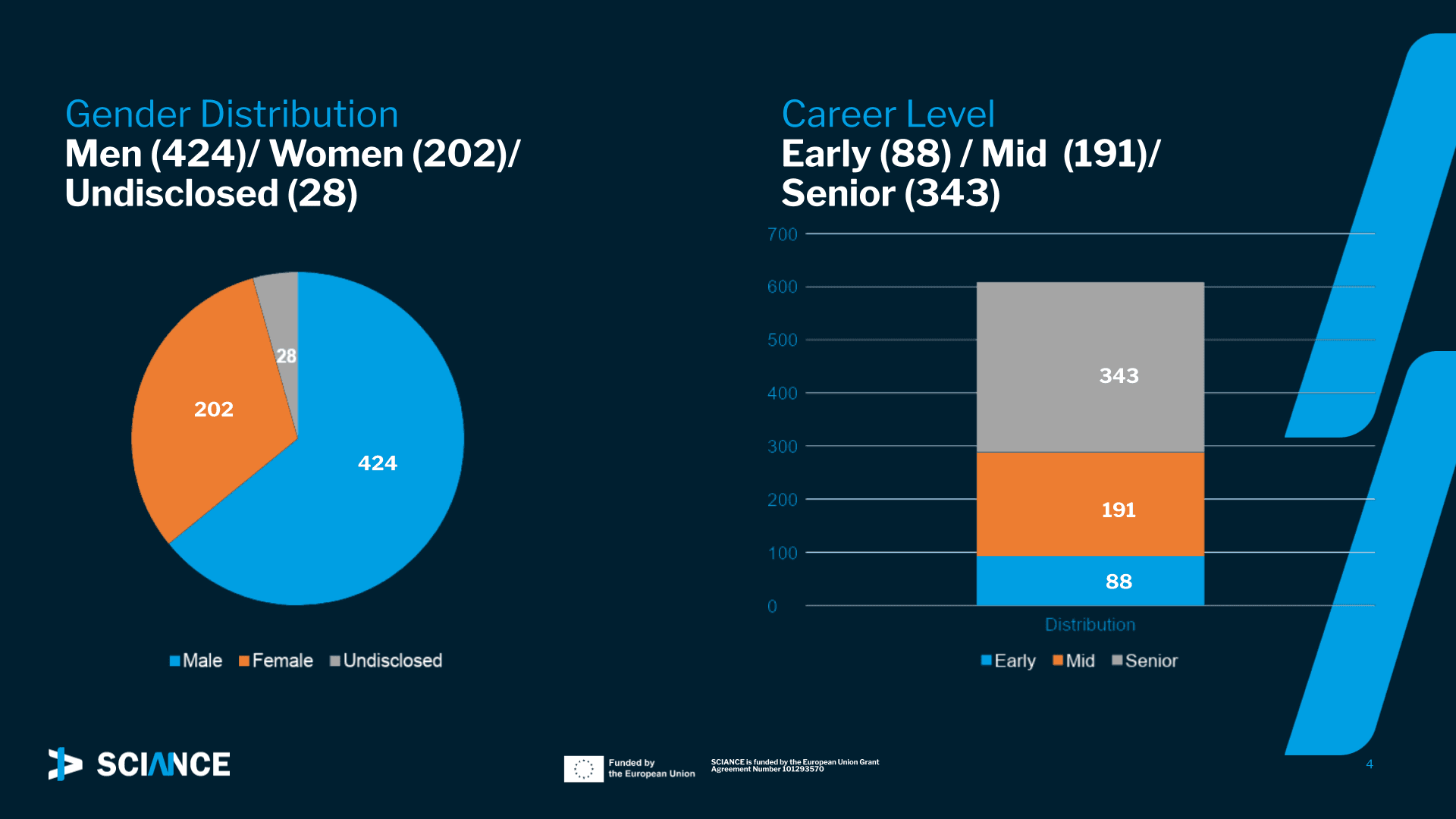
In total, 202 women and 424 men applied. 88 registrants identified as ‘early career’, and 343 as ‘senior’.
The applicant pool draws from a wide array of backgrounds, with academia representing 70% of the interest, supported by significant contributions from research centres and infrastructures. 36 applications represent ‘industry’ – ensuring that the perspective from businesses and SMEs will be included in the Working Group discussions. Geographically, we identified participants from 37 countries, with participants from the United Kingdom (54), Germany (52), and the Netherlands (52), and strong participation from Spain (32), Italy (30), Switzerland (18), Belgium (16), Portugal (16), and Sweden (15).
Next steps
Following this successful call, the project team will now undertake a detailed selection process. Working Group members will be engaging in interdisciplinary discussions during in-person co-creation workshops, help validate research priorities, infrastructure scenarios, and community recommendations, review and contribute SCIANCE project activities and outputs – in particular the Strategic Research & Innovation Agenda (SRIA) – and disseminate SCIANCE results within their professional networks and communities.
All applicants will receive a message about the status of their application in May. Applicants that missed the deadline or that are not selected for the Working Groups will still have the opportunity to contribute to community consultations, other AI in science activities, and be invited to contribute to shaping the AI in Science community and to the SCIANCE Strategic Research & Innovation Agenda (SRIA). Make sure to register for our newsletter to remain in the loop!